
Property & Investment · Maine
Buying Waterfront Property in Maine: Oceanfront, Lakefront and Riverfront Homes
What Maine waterfront buyers should investigate, from shoreland rules and access rights to utilities, insurance, inspections and seasonal considerations.

On this page
- Types of Maine Waterfront Property
- Understand Maine Shoreland Zoning
- Flood Risk and Insurance
- Erosion, Tides and Changing Conditions
- Docks, Piers and Moorings
- Septic Systems, Wells and Water Quality
- Title, Boundaries and Legal Access
- Financing and Appraisal
- Seasonal Versus Year-Round Use
- Rental and Investment Use
- Waterfront Due-Diligence Checklist
- Searching for Waterfront Property in Maine
- Maine Waterfront Property FAQ
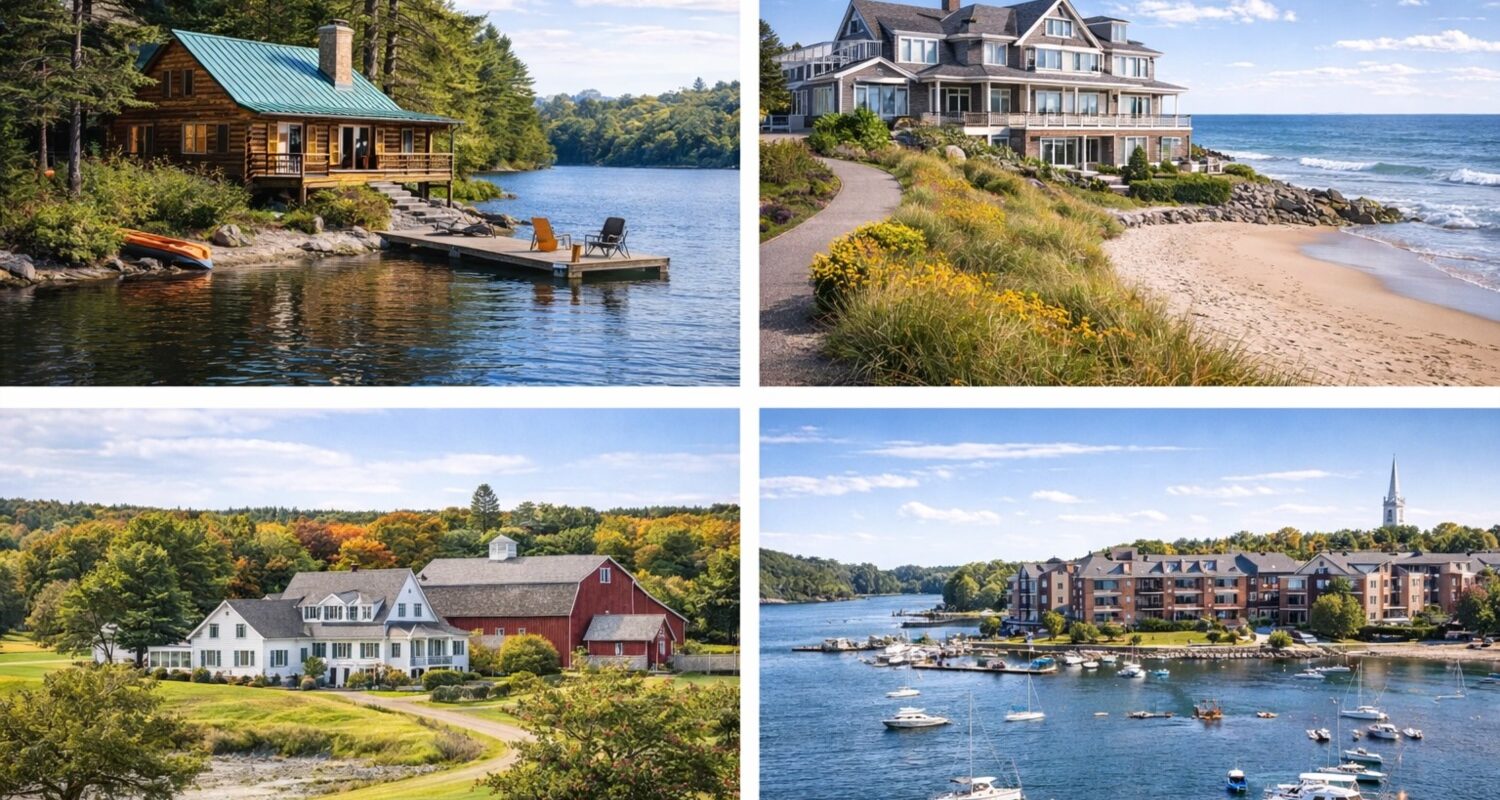
Buying waterfront property in Maine can mean very different things: an oceanfront home exposed to tides and storms, a lake house on a great pond, a riverfront property, or a home with deeded access rather than direct frontage. Each carries its own legal, environmental, insurance, maintenance, and financing questions. Investigate the exact parcel, waterbody, municipality, and proposed use before treating “waterfront” as a single property category.
Types of Maine Waterfront Property
Ocean and tidal frontage
Coastal property requires attention to elevation, flood exposure, erosion, saltwater corrosion, tidal access, and the condition and legal status of docks, piers, seawalls, and other shoreline structures. A protected cove and an exposed beach can have very different risk profiles even within the same town.
Lake and pond frontage
Lakefront buyers should confirm whether the waterbody is a “great pond” under Maine law, review local shoreland zoning, verify water-quality information, and understand restrictions on vegetation clearing, structures, septic systems, and waterfront access.
River and stream frontage
Riverfront property can involve floodplain, bank stability, current, seasonal water-level changes, and restrictions tied to the size and legal classification of the waterbody. Do not assume that rules for a lake or ocean parcel apply in the same way to a river or stream.
Deeded or shared access
A property marketed with beach, dock, or lake access may not own direct frontage. Review the deed, easements, association documents, maintenance obligations, parking rights, and any limits on guests, boats, docks, or seasonal use.
Understand Maine Shoreland Zoning
Maine’s Mandatory Shoreland Zoning Act requires municipalities to regulate land use in designated shoreland areas. According to the Maine Department of Environmental Protection, the shoreland zone generally includes land within 250 feet of the normal high-water line of a great pond or river, the upland edge of coastal wetlands and defined freshwater wetlands, and land within 75 feet of certain streams.
Those distances define the regulated shoreland zone; they are not a universal building setback. Structure setbacks, expansion limits, vegetation standards, permitted uses, and review procedures depend on state minimum standards, the municipality’s ordinance, the resource, the zoning district, and whether an existing structure is nonconforming. Municipalities may adopt standards that are more restrictive than the state minimum.
Before buying, contact the local code-enforcement or planning office and request the current shoreland zoning map and ordinance for the parcel. If renovations, additions, tree removal, a dock, a new septic system, or other work matters to your plans, ask for written guidance about required permits and whether the proposed work is feasible.
Flood Risk and Insurance
Waterfront does not automatically mean that an entire property lies in a FEMA high-risk flood zone, and flood exposure can vary across a single parcel. Review the current FEMA Flood Insurance Rate Map, any elevation certificate, prior flood claims, local drainage and storm history, and the building’s elevation and foundation.
Start with the FEMA Flood Map Service Center, then confirm requirements with the lender and qualified insurance professionals. A lender may require flood insurance when a secured structure is in a Special Flood Hazard Area, but a buyer outside a mandatory zone may still choose coverage after evaluating risk.
Obtain property-specific homeowners and flood-insurance quotes during due diligence. Premiums depend on elevation, construction, occupancy, claims history, coverage, deductible, and underwriting. Statewide price ranges are not a reliable substitute for an actual quote.
Erosion, Tides and Changing Conditions
For coastal, bluff, riverbank, or steep lakefront sites, investigate erosion and slope stability. Historic aerial imagery, surveys, municipal records, and consultation with a qualified engineer or geologist can help identify concerns that are not obvious during a single showing.
Tidal buyers should observe the property at different tide levels and weather conditions. Confirm usable water depth, currents, seasonal access, and how the shoreline behaves during storms. A protected harbor, salt marsh, ledge, and sandy beach present different maintenance and risk questions.
Review available state and municipal planning information concerning sea-level rise, storm surge, culverts, roads, and emergency access. The goal is to understand how the property and its access may perform over the period you expect to own it.
Docks, Piers and Moorings
Do not assume that frontage creates an automatic right to construct or replace a dock, pier, wharf, seawall, or mooring. Existing structures may be permitted, grandfathered, licensed, seasonal, shared, or nonconforming. Ask for permits, plans, maintenance records, and evidence that the structure is located within the property’s rights.
Depending on the work and resource, review may involve the municipality, Maine DEP, the local harbor master, and potentially federal agencies. Mooring availability and rules are often administered locally. Verify what transfers with the property and what requires a new application.
Septic Systems, Wells and Water Quality
Many waterfront properties rely on private septic systems and wells. Have the septic design, age, maintenance history, disposal field, reserve area, and current condition reviewed by qualified professionals. Confirm whether the lot can support repair or replacement under current rules rather than assuming an older system can be replaced in the same location.
Test private well water using appropriate laboratory analysis and evaluate well yield, construction, and location. Coastal and tidal properties may warrant additional attention to salinity or saltwater intrusion. Lake and pond buyers should also review public water-quality information and local association or watershed resources.
Title, Boundaries and Legal Access
Waterfront value often depends on rights that should be documented rather than assumed. Review the deed, survey, easements, rights of way, shared roads, association documents, beach rights, dock rights, mooring rights, and any covenants affecting use.
Confirm the location of the high-water line, property boundaries, and any encroachments with qualified professionals when those issues are material. A lawn, path, beach, dock, or driveway that appears private may be subject to shared or public rights.
For seasonal or private roads, investigate maintenance agreements, plowing, emergency access, legal access, lender requirements, and the allocation of repair costs.
Financing and Appraisal
Waterfront properties may require additional underwriting because of flood risk, seasonal occupancy, private roads, nonconforming structures, unusual comparable sales, or insurance availability. Discuss the property type with a lender early and avoid relying on a generic preapproval.
Appraisal can be more complex when comparable waterfront sales are limited or when frontage, view, access, dock rights, and site characteristics differ. Buyers should understand how an appraisal shortfall would be handled under the financing and appraisal terms of the offer.
Seasonal Versus Year-Round Use
A seasonal camp may not have the insulation, heating, water system, road access, foundation, or septic capacity expected of a year-round home. Confirm permitted occupancy, winter access, utility availability, and what improvements would be required before assuming conversion is possible.
For any property that will be vacant for part of the year, plan for winterization, freeze protection, storm monitoring, security, dock removal or storage, insurance restrictions, and local property-management options.
Rental and Investment Use
If rental income is part of the purchase decision, verify current municipal short-term-rental rules, registration requirements, occupancy limits, septic capacity, parking, association restrictions, insurance, and tax obligations. Regulations can change, and prior rental activity does not guarantee future approval.
Build projections using conservative occupancy, realistic management and maintenance costs, and property-specific insurance and financing. Waterfront maintenance and weather exposure can make historical gross revenue a poor measure of future net income.
Waterfront Due-Diligence Checklist
- Confirm the exact type and extent of frontage or deeded access.
- Review the deed, survey, easements, association documents, and road agreements.
- Review municipal zoning, shoreland zoning, permitted uses, and any nonconforming status.
- Verify permits for docks, piers, seawalls, additions, and shoreline work.
- Review FEMA mapping, elevation information, prior flooding, and storm access.
- Obtain property-specific homeowners and flood-insurance quotes.
- Inspect the building, foundation, shoreline, slope, septic system, well, and water quality.
- Confirm road, emergency, winter, dock, and mooring access.
- Discuss the property with a lender and understand appraisal contingencies.
- Verify rental, seasonal-use, and renovation plans before relying on them.
Searching for Waterfront Property in Maine
Begin with the setting and use you want—ocean, lake, river, direct frontage, shared access, year-round living, seasonal use, or rental potential—then narrow the search using the questions above. Browse current Maine homes for sale, learn about Maine communities and markets, or contact Bean Group for help evaluating a particular waterfront property.
Maine Waterfront Property FAQ
Does Maine require every waterfront structure to be 250 feet from the water?
No. The 250-foot figure commonly describes the extent of the regulated shoreland zone for specified resources, not a universal structure setback. The applicable setback and expansion rules depend on the resource, municipal ordinance, district, proposed work, and any nonconforming status.
Is every Maine waterfront property in a high-risk FEMA flood zone?
No. Flood-zone designations and risk vary by parcel and even within a parcel. Review the current map and property-specific elevation information, then obtain insurance and lender guidance.
Can I build a dock because I own waterfront land?
Not automatically. Local, state, and sometimes federal approvals may apply, and moorings are generally subject to local harbor rules. Verify permits and feasibility before purchasing based on a planned dock or mooring.
What professionals may be useful during due diligence?
Depending on the property, the team may include a waterfront-experienced real estate agent, home inspector, surveyor, title professional or attorney, septic professional, well or water-quality specialist, engineer or geologist, insurance professional, lender, municipal code officer, and harbor master.